














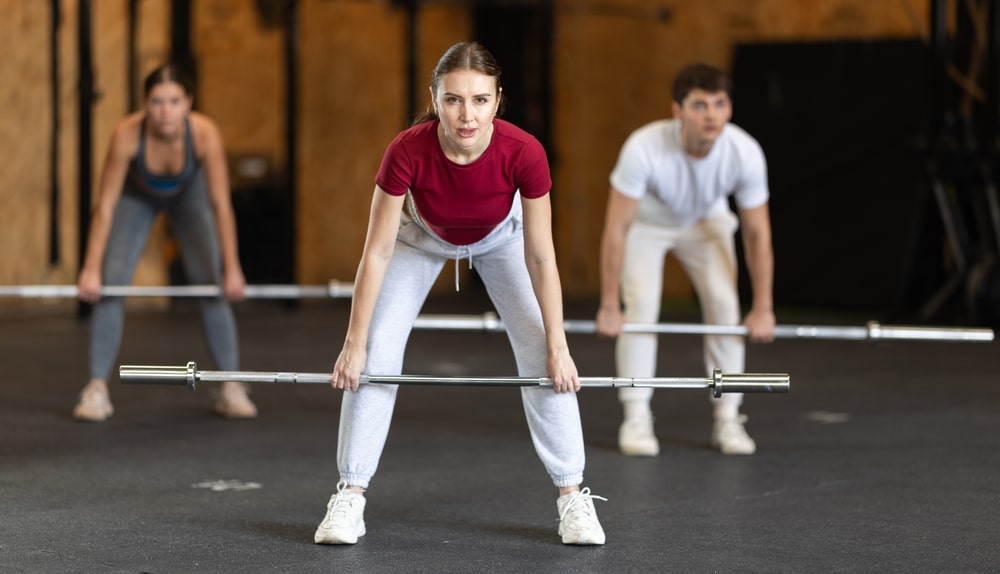
How to Master the Dumbbell Romanian Deadlift
- Begin by holding a dumbbell in each hand. Your arms should hang naturally at your sides with your palms facing your body.
- Set your foundation by standing with your feet slightly narrower than shoulder-width apart. Point your toes out just a bit and maintain a “soft” or slight bend in your knees. Keep your chest elevated, pull your shoulders back, and engage your core by taking a breath into your midsection.
- Initiate the movement by pushing your glutes backward. Maintaining a flat back, allow the dumbbells to slide down the front of your thighs in a vertical path. It is crucial to keep the weights tucked close to your legs throughout the descent. Avoid increasing the bend in your knees; keeping them at a fixed, slight angle ensures the load remains on your hamstrings.
- Lower the weights until you feel a significant stretch along the back of your thighs. For most people, this occurs when the dumbbells are just below the kneecaps. Stop immediately if you feel your lower back beginning to round or lose its natural arch.
- Reverse the motion by driving your hips forward to return to a standing position. Keep your core braced and your arms straight, finishing the rep by standing tall.
Advanced Performance Tips for Better Results
- If you find it difficult to engage your posterior chain, focus on keeping your center of gravity over your midfoot while maintaining high hip positioning. Ensure the dumbbells stay close to your shins and only lower them to the point where your hamstrings feel fully lengthened.
- To stabilize your upper body and prevent your back from rounding, imagine you are trying to squeeze an orange in each armpit. This “lat squeeze” creates total-body tension and protects the spine.
- Don’t let your grip be the limiting factor. If your hands give out before your legs are fatigued, consider using lifting straps. This allows you to focus entirely on the hamstrings and glutes without worrying about the dumbbells slipping.
- To conserve energy for your actual work sets, avoid picking the dumbbells up from the floor. Instead, rest them on a weight bench or the top tier of a rack between sets so you can begin the movement from a standing position.
- Maintaining a consistent, slight bend in the knees is often more comfortable for the joints and allows for a slightly deeper range of motion while keeping the tension where it belongs.
Strategic Programming and Equipment Selection
The dumbbell Romanian deadlift (RDL) is an effective tool for building the hamstrings, glutes, and lower back. However, when compared to the barbell version, there are specific trade-offs to consider. A barbell is often easier to stabilize and allows for more precise progressive overload, as most dumbbells only increase in large increments and have a lower weight ceiling.
That said, dumbbells are an excellent alternative for those training in home gyms, during travel, or for individuals who find the independent movement of dumbbells more comfortable for their anatomy. If you have access to both, the barbell is generally preferred for heavy strength gains, while dumbbells work well for higher-repetition hypertrophy work.
For optimal results, integrate this exercise into your lower-body or leg-focused training sessions. A common and effective prescription is 3 sets of 8 to 10 repetitions. Ensure you leave 2 to 3 “reps in reserve”—meaning you stop just short of total muscular failure—and rest for 2 to 3 minutes between sets to allow for adequate recovery.
Primary Muscles Targeted and Common Execution Errors
The dumbbell RDL is a powerhouse move for the posterior chain. It primarily targets the hamstrings and the glutes, while the spinal erectors work hard to maintain a neutral posture. Secondary muscles involved include the adductors (inner thighs), the forearms (for grip), and the quadriceps, which act as stabilizers.
If you aren’t feeling the target muscles working, consider these three common fixes:
- Check Your Depth: Many lifters try to go too low. When you go past your natural range of hamstring flexibility, your knees usually bend more or your back rounds, shifting the work to your quads and lower back. Stop once your hamstrings are fully stretched.
- Be Patient with the Learning Curve: The “mind-muscle connection” for a hip-hinge movement can take several weeks to develop. Consistency is key to feeling the right muscles fire.
- Minimize Distractions: Focus on the tension in the back of your legs. External distractions often break the concentration required to maintain proper form and muscle engagement.
Even if you don’t feel a “pump” in your hamstrings immediately, following the correct technical cues ensures that the mechanical tension is being applied to the right areas for growth and strength.
Final Thoughts on the Dumbbell RDL
The dumbbell Romanian deadlift is a versatile and highly effective hinge movement that builds foundational lower-body strength. By prioritizing a flat back, maintaining a proper hip hinge, and focusing on the stretch of the hamstrings rather than just reaching for the floor, you can safely maximize muscle development. Whether used as your primary hinge or as a supplemental exercise to barbell work, mastering this movement is a valuable addition to any fitness routine.
A common misconception in strength training is that you must “feel” a specific muscle working for it to grow. In reality, the sensation of a muscle contraction—often referred to as the mind-muscle connection—does not always correlate with the actual level of hypertrophy occurring. Even if you don’t feel a deep burn in your glutes or hamstrings during every rep, they are still being stimulated by the mechanical tension of the movement.
While the dumbbell Romanian deadlift (RDL) is a cornerstone exercise for the posterior chain, it is rarely enough on its own to achieve maximum development. To build truly impressive legs and glutes, you need a more comprehensive approach that includes specific accessory movements.
The hamstrings are a complex muscle group with two primary functions: hip extension and knee flexion. The RDL is an elite movement for hip extension, but it does not address knee flexion. Furthermore, the hamstrings consist of four distinct muscle heads. Three of these cross both the hip and knee joints, but the short head of the biceps femoris only crosses the knee. Because of this anatomy, the short head is barely engaged during hip-hinging movements like the RDL.
Scientific research indicates that different exercises target different regions of the hamstrings. Hip hinges tend to emphasize the semimembranosus, while knee-flexion exercises—such as leg curls or Nordic curls—better activate the semitendinosus and the short head of the biceps femoris. To ensure you aren’t leaving gains on the table, it is essential to pair your RDLs with a movement that involves bending the knee under resistance.
The same logic applies to the glutes. While RDLs provide a great stretch, most lifters find they need isolation work to reach their full potential. Movements like the squat provide heavy loading in a lengthened position, while the hip thrust allows you to isolate the glutes and drive them to failure even after your other leg muscles are exhausted.
Optimized Training Routines Featuring the Dumbbell RDL
To maximize the effectiveness of this exercise, it should be integrated into a well-structured program. Here are four ways to organize your training sessions based on your specific goals.
Comprehensive Lower-Body Strength Session
Goblet Squat: 3 sets of 8–12 reps
Dumbbell Romanian Deadlift: 3 sets of 8–12 reps
Leg Press: 3 sets of 8–12 reps
Seated Leg Curl: 3 sets of 8–12 reps
Advanced Hamstring Hypertrophy Routine
Dumbbell Romanian Deadlift: 3 sets of 8–12 reps
Dumbbell Bulgarian Split Squat: 3 sets of 8–12 reps
Lying Leg Curl: 3 sets of 8–12 reps
Standing Calf Raise: 3 sets of 8–12 reps
Targeted Glute Isolation Program
Hip Thrust (or Machine Hip Thrust): 3 sets of 8–12 reps
Dumbbell Romanian Deadlift: 3 sets of 8–12 reps
Dumbbell Bulgarian Split Squat: 3 sets of 8–12 reps
Lying Leg Curl: 3 sets of 8–12 reps
Minimal Equipment Home or Travel Workout
Dumbbell Goblet Squat: 3 sets of 8–12 reps
Dumbbell Romanian Deadlift: 3 sets of 8–12 reps
Dumbbell Bulgarian Split Squat: 3 sets of 8–12 reps
Nordic Curl: 3 sets to failure
For most lifters, the ideal way to program the dumbbell RDL is early in the workout. Because it is a demanding compound movement that requires significant stability and grip strength, performing it while you are fresh ensures better form and higher intensity. A standard recommendation is to perform 2–3 sets of 8–12 reps.
Progression is the most critical factor for long-term muscle growth. Use a “double progression” model: start at the bottom of the rep range and work your way up to 12 reps. Once you can comfortably perform 12 reps with good form, increase the weight and start the process over. If your gym only has large jumps in dumbbell weights (e.g., 10-pound increments), you may find it helpful to expand your rep range to 10–15 before increasing the load. This is one reason why some advanced lifters eventually transition to the barbell RDL, as it allows for smaller, more precise weight increases.
Barbell vs. Dumbbell: Choosing the Best RDL Variation
Mechanically, your muscles cannot distinguish between the tension provided by a dumbbell and that of a barbell. Both tools are highly effective for stimulating the glutes and hamstrings. However, from a practical standpoint, the barbell often provides a superior platform for long-term progression for several reasons:
- Incremental Loading: Most gyms have small weight plates (1.25 to 2.5 lbs), allowing you to add as little as 2.5 to 5 pounds to a barbell at a time. This makes it much easier to stay on a consistent upward trajectory.
- Higher Weight Ceiling: You can load a barbell with hundreds of pounds, whereas many commercial gyms stop their dumbbell sets at 100 pounds.
- Ease of Setup: Pulling a heavy barbell off a squat rack at hip height is significantly easier and safer than picking up heavy dumbbells from the floor or a low rack.
If you have access to a barbell, it is generally the better choice for your primary hip-hinge movement. However, dumbbells remain an excellent option for beginners, those training at home, or lifters who find the independent movement of dumbbells more comfortable for their joints.
Final Thoughts on Optimizing Your Lower Body Training
The dumbbell RDL is an exceptional exercise for developing the posterior chain, but it is most effective when used as part of a diverse training plan. By understanding that different parts of the hamstrings require different movements—specifically combining hip-hinging with knee-flexion—you can build a more balanced and functional lower body. Focus on progressive overload, prioritize form over heavy weights initially, and ensure you are hitting the muscles from multiple angles for the best aesthetic and performance results.