















Step-by-Step Guide to the Dumbbell Bench Press
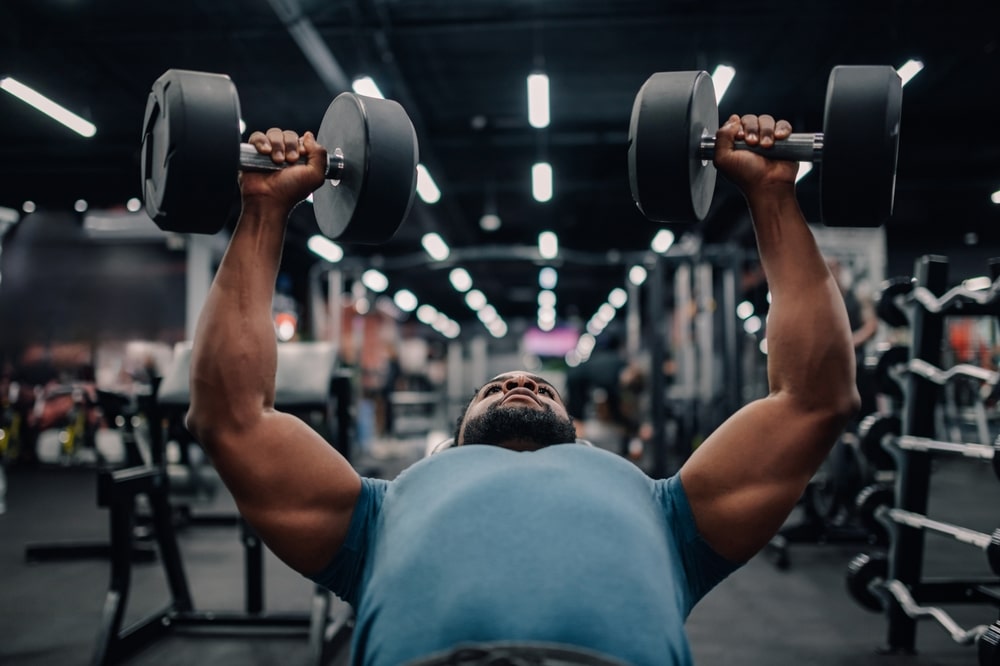
- Sit upright on the edge of a flat weight bench. Place a pair of dumbbells vertically on your thighs, gripping the handles firmly.
- Slowly lie back while simultaneously using your knees to “kick” the dumbbells toward your chest. This momentum helps you transition into a flat position with the weights held at the sides of your torso.
- Retract your shoulder blades by pulling them together and downward. Press the dumbbells toward the ceiling until your arms are fully extended and locked out over your chest.
- Lower the weights under control, following the same path back down until you feel a comfortable stretch in your chest.
- To finish the set safely, either lower the weights to your chest and carefully drop them to the floor, or bring your knees up to meet the dumbbells, allowing the weight to pull you back into a seated position.
Pro Techniques for Better Gains and Joint Health
- Getting heavy dumbbells into the starting position is often the hardest part of the lift. Using your thighs to assist the weights as you lie back is the safest way to preserve energy and protect your shoulders.
- To stabilize your torso, imagine tucking your shoulder blades into your back pockets. This creates a solid foundation to press from and protects the rotator cuff.
- Allow the dumbbells to naturally move slightly toward each other at the top of the movement. However, do not feel obligated to touch them together; keeping them directly over your shoulders maintains constant tension on the pectoral muscles.
- Focus on a deep range of motion. Lower the weights until the handles are roughly level with your chest or nipples. Research indicates that training a muscle through its full lengthened state is superior for muscle hypertrophy.
- Maintain a sturdy base by keeping your feet planted firmly on the ground and your glutes in contact with the bench. A slight natural arch in the lower back is acceptable and helps maintain a neutral spine.
- Take advantage of the freedom of movement. Unlike a barbell, dumbbells allow your wrists to rotate naturally. If you experience discomfort, try a slight neutral grip (palms facing each other) to alleviate stress on the elbows and shoulders.
- Identify strength discrepancies by observing if one arm lags behind the other. If one side is weaker, choose a weight that the weaker arm can handle with perfect form to ensure balanced development.
The Benefits and Limitations of Dumbbell Pressing
The dumbbell bench press is a foundational movement for developing the chest, anterior deltoids, and triceps. It is a staple in many effective strength programs because it allows for high levels of mechanical tension and a significant range of motion.
One of the primary advantages over the barbell bench press is joint comfort. Because your hands are not fixed to a rigid bar, your wrists and elbows can move through a more natural path. This makes it an ideal alternative for lifters dealing with minor shoulder “niggles” or tendinitis. Furthermore, it prevents the dominant side of the body from overcompensating, which helps correct muscle imbalances over time.
However, there are a few practical trade-offs to consider:
First, while the range of motion is slightly deeper than a barbell press, the difference is marginal. Over-stretching at the bottom can sometimes lead to shoulder irritation rather than extra muscle growth if not handled carefully. Second, as you progress to heavier weights, the act of “setting up” the dumbbells becomes a workout in itself, which can be fatiguing before you even start the set. Finally, dumbbells require more stabilization. While this recruits more “stabilizer” muscles, it can also mean those smaller muscles fail before your chest is fully exhausted.
To maximize results, it is often best to pair the dumbbell bench press with other movements like machine presses or barbell work. For most lifters, performing 3 sets of 4–6 or 6–8 reps with 2–3 minutes of rest between sets provides an ideal balance of strength and hypertrophy. Aim to finish each set feeling as though you could have completed one or two more reps (1–2 reps shy of failure).
Effective Variations and Alternatives
- Barbell Bench Press: The standard for raw strength, allowing for heavier loading and easier setup.
- Incline Dumbbell Bench Press: Performed on a 30-to-45-degree angle to shift more emphasis onto the upper chest (clavicular head).
- Incline Barbell Bench Press: Combines the heavy loading of a barbell with the upper-chest focus of an incline.
- Machine Chest Press: Removes the need for stabilization, allowing you to push the pectoral muscles to absolute failure safely.
- Chest Dips: A powerful bodyweight movement that targets the lower chest and triceps; can be progressed with a weighted belt.
- Push-Ups: A fundamental horizontal press that is excellent for beginners or as a high-rep finisher.
Sample Training Templates
The following routines demonstrate how to integrate the dumbbell bench press into different training splits. Use “double progression” for these workouts: once you can hit the top end of the rep range for your first set, increase the weight for the next session.
Option 1: The Hypertrophy Chest Session
This session focuses on high-volume pectoral development.
- Dumbbell Bench Press: 3 sets of 4–6 reps (2–3 min rest)
- Incline Dumbbell Bench Press: 3 sets of 6–8 reps (2–3 min rest)
- Machine Chest Press: 3 sets of 6–8 reps (1–2 min rest)
- Dumbbell Chest Fly: 3 sets of 8–10 reps (1–2 min rest)
Option 2: The Upper-Body Push Routine
This routine targets the chest, shoulders, and triceps in a single session.
- Dumbbell Bench Press: 3 sets of 4–6 reps (2–3 min rest)
- Incline Dumbbell Bench Press: 3 sets of 6–8 reps (2–3 min rest)
- Triceps Pushdown: 3 sets of 8–10 reps (1–2 min rest)
- Dumbbell Lateral Raise: 3 sets of 8–10 reps (1–2 min rest)
Option 3: The Total-Body Strength Plan
A balanced approach for those training the whole body in one workout.
- Barbell Back Squat: 3 sets of 4–6 reps (2–3 min rest)
- Dumbbell Bench Press: 3 sets of 6–8 reps (2–3 min rest)
- One-Arm Dumbbell Row: 3 sets of 6–8 reps (2–3 min rest)
- Dumbbell Lateral Raise: 3 sets of 8–10 reps (1–2 min rest)
Final Takeaway
The dumbbell bench press is a versatile and highly effective exercise for building a strong, symmetrical chest while protecting your joints. By mastering the setup, focusing on a full range of motion, and utilizing a progressive overload strategy, you can overcome the inherent stability challenges of the movement and see significant upper-body gains. Whether used as a primary lift or a secondary accessory, it remains one of the best tools for targeted muscle hypertrophy and long-term shoulder health.
Comparing the Dumbbell and Barbell Bench Press for Chest Development
The flat barbell bench press is often hailed as the definitive exercise for building chest mass and upper-body power. While this reputation is well-earned, it is not the only way to develop a strong physique. Understanding the nuances between using a barbell and dumbbells can help you optimize your training routine.
One primary advantage of the barbell is the ability to move heavier loads. On average, lifters can handle approximately 17% more weight with a barbell than they can with dumbbells. This capacity for heavier resistance makes the barbell an excellent tool for progressive overload, a key driver of muscle growth. Because the barbell is a fixed object held by both hands, it requires less stabilization, allowing you to focus purely on the pressing movement.
However, research indicates that the dumbbell bench press may lead to slightly higher activation of the pectoral muscles. This is likely due to the increased range of motion and the stabilization required to control two independent weights. Rather than one being strictly superior, both exercises offer unique benefits. Both generate significant mechanical tension and allow for gradual weight increases over time.
Choosing between them often comes down to individual goals and comfort. Some lifters find that dumbbells are easier on their joints or provide a more natural path of motion. A balanced approach is often best: you might rotate between the two every 8 to 10 weeks or incorporate both into your weekly chest sessions to reap the benefits of each.
Dumbbell Bench Press Strength Standards and Benchmarks
A common rule of thumb is that your total dumbbell press weight (the sum of both dumbbells) should be roughly 80% of your barbell bench press max. For instance, if you can barbell press 200 pounds, a comparable feat would be pressing a pair of 80-pound dumbbells (160 pounds total).
However, strength is a skill. If you rarely use dumbbells, your numbers may initially be lower as you develop the necessary coordination. To gauge your progress, you can use the following strength standards based on body weight:
Dumbbell Press Standards for Men:
- Beginner (0–12 months training): 0.6 x body weight
- Intermediate (1–3 years training): 0.9 x body weight
- Advanced (3+ years training): 1.2 x body weight
Dumbbell Press Standards for Women:
- Beginner (0–12 months training): 0.3 x body weight
- Intermediate (1–3 years training): 0.5 x body weight
- Advanced (0.7 x body weight): 0.7 x body weight
These benchmarks represent a one-repetition maximum (1RM) using the combined weight of both dumbbells. Data suggests that most people can lift nearly 20% more on a barbell than they can with dumbbells. You can use this ratio to estimate your potential on either lift. If you can successfully press 80-pound dumbbells for a single rep, you likely have the strength to barbell press approximately 200 pounds.
Primary Muscles Targeted During Dumbbell Chest Presses
The dumbbell bench press is a compound movement that recruits several major muscle groups in the upper body. The primary movers include:
- Pectoralis Major: This is the largest muscle of the chest. The flat version of the press specifically targets the middle and lower sections (the sternocostal head).
- Anterior Deltoids: The front portion of your shoulders assists in the pressing motion.
- Triceps Brachii: Located on the back of the arms, these muscles are responsible for extending the elbows to lock out the weight.
It is important to note that while the flat press is highly effective for the mid-to-lower chest, it is less effective at targeting the “upper chest” or clavicular head. To fully develop the upper portion of the pectorals, many training programs pair the flat dumbbell press with incline pressing movements.
Supplementary Chest Movements and Training Tips
To build a well-rounded chest, variety is key. While the flat dumbbell press serves as a foundational movement, incorporating different angles and equipment can ensure all areas of the pectoral muscles are stimulated. Consistency and proper form remain the most critical factors for long-term progress and injury prevention.
Summary and Final Takeaways
Both the barbell and dumbbell bench press are elite exercises for increasing upper-body strength and muscle mass. While the barbell allows for maximum loading and easier progressive overload, dumbbells offer superior muscle activation and a greater range of motion. By understanding the strength standards for your experience level and ensuring you target all areas of the chest—including the upper pectorals through incline work—you can create a highly effective and balanced training routine. Whether you choose one or alternate between both, the key to success lies in consistent effort and gradual increases in resistance.