
















Step-by-Step Guide to Performing the Overhead Press
- Set your power rack hooks so the barbell sits at mid-chest height, just below the collarbones. Facing the rack, grasp the bar with a slightly wider than shoulder-width grip, ensuring your palms face forward and your thumbs are fully wrapped around the bar.
- Place the barbell deep in the base of your palms, close to the wrists. Avoid letting the bar roll back into your fingers; your wrists should remain relatively straight to provide a solid foundation for the weight.
- With a minor bend in your knees, position the bar across your anterior deltoids and upper chest. Lift the bar from the rack by straightening your legs, then take a controlled step backward with each foot to establish your lifting stance.
- Draw a deep breath into your core to create internal pressure. Lean your upper torso back slightly so the bar can travel vertically without hitting your chin. Squeeze your glutes and grip the bar tightly, then drive the weight upward in a straight line over the middle of your feet.
- As the barbell clears your forehead, move your head and chest forward, “entering” the space under the bar. Continue the upward drive until your elbows are fully locked out. Lower the bar back to your chest with control to complete the repetition.
Pro Techniques for Better Performance and Safety
- Maintain a neutral wrist position throughout the movement. Aligning the bar directly over your forearms prevents unnecessary strain and ensures efficient force transfer from your arms to the barbell.
- Utilize the “window” cue: as the bar reaches eye level, imagine pushing your chest through an imaginary window created by your arms. This helps transition the weight into the lockout position more effectively.
- Keep your forearms vertical and parallel to each other when viewed from the front. A grip that is too wide can make the initial phase of the lift significantly more difficult and reduce your ability to stabilize the weight at the top.
- Practice proper bracing by inhaling to about 80% of your lung capacity before you press. Press your tongue against the roof of your mouth and tighten your abdominal muscles as if bracing for an impact. This creates the intra-abdominal pressure necessary to protect your spine and maintain a rigid torso.
- Focus on explosive intent by imagining you are trying to “throw” the barbell into the ceiling. Directing your focus toward the environment rather than internal body mechanics often leads to more powerful and fluid movements.
- Control the descent but do not move too slowly. The downward phase should be steady and intentional, typically taking less than one second, to preserve energy for your next repetition.
- Generate full-body tension by squeezing your glutes as hard as possible. This stabilizes the pelvis and prevents excessive arching of the lower back during heavy sets.
Perspective on Training Utility and Progress
The overhead press is a foundational metric for upper-body power. While it may not be part of the traditional powerlifting “Big 3,” it is a staple in Olympic weightlifting and strongman training because it serves as an uncompromising test of raw strength.
Incorporating this lift into a well-rounded strength program can lead to significant gains in muscle mass, particularly for the shoulders and triceps. However, its effectiveness can vary based on individual mechanics and training goals.
One challenge with the overhead press is that it heavily targets the anterior deltoids, which are already highly active during bench pressing and other chest exercises. Additionally, the triceps often reach failure before the shoulders do, meaning it can sometimes act more as an arm-builder than a pure shoulder exercise. For some lifters, anatomical differences mean the movement feels uncomfortable or produces slower muscle growth compared to other pressing variations.
Despite these factors, the barbell overhead press remains a top-tier choice for building the shoulders and triceps. If the standing version is not yielding the desired results, transitioning to a seated variation can be a smart move. Seated presses often allow for better isolation of the target muscles because the core and lower back are less of a limiting factor. This is particularly useful if you are already performing heavy squats and deadlifts that tax your midsection.
Choosing a barbell over dumbbells offers several technical advantages, including easier setup with heavy weights and the ability to progress in smaller, more manageable weight increments. However, the standing barbell press is often preferred for general athleticism. As a closed-kinetic-chain exercise where your feet are anchored to the floor, it builds superior balance, stability, and engagement of the stabilizer muscles compared to open-kinetic-chain movements.
For most lifters, a solid programming approach is 3 sets of 4 to 6 repetitions, resting 2 to 3 minutes between sets. Aim to finish each set with 1 or 2 reps left in the tank. It is important to remember that progress on this lift is often slower and less consistent than on the bench press or squat. Because it involves a smaller muscle group and requires high technical precision, patience is key.
Effective Variations to Consider
- Seated Barbell Overhead Press: By removing the need for total-body stabilization, this variation typically allows you to lift 10% to 20% more weight. It is an excellent choice for those looking to maximize shoulder hypertrophy while minimizing lower back fatigue.
Summary of Key Takeaways
The barbell overhead press is a premier exercise for developing upper-body strength and structural stability. Success with this lift requires strict attention to setup, specifically regarding wrist alignment and core bracing. While it is a challenging movement to master and progress can be slow, its benefits for the shoulders, triceps, and overall athletic performance make it a valuable addition to most training regimens. If the standing version does not align with your current goals or anatomy, utilizing seated variations or adjusting your programming can help you continue building muscle and strength efficiently.
- Dumbbell Shoulder Press. Many lifters find using dumbbells more natural for their joints. Research suggests this variation may lead to higher deltoid activation, though it can be more challenging to stabilize and set up, particularly when performing the movement standing.
- Arnold Press. This variation involves a rotational component that some studies suggest increases engagement in both the anterior and lateral deltoids. For most training purposes, it serves as a functional alternative to the standard dumbbell press.
- Machine Overhead Press. This is an excellent choice for those looking to maximize hypertrophy. By removing the need for balance and stabilization, machines allow you to focus purely on driving the weight and fatiguing the shoulders and triceps.
- Incline Barbell Bench Press. While technically a chest exercise, the incline press targets many of the same muscle groups. It places more emphasis on the upper pectorals and less on the side delts. Pairing this with lateral raises is a common strategy for comprehensive upper-body development.
- Incline Dumbbell Bench Press. This offers the same benefits as the barbell version but requires more stabilizer muscle involvement and allows for a more individualized range of motion.
- Push Press. This variation utilizes a slight leg drive to assist the initial phase of the lift. While it allows for moving significantly heavier loads, the “cheat” momentum makes it slightly less efficient for pure isolated muscle growth compared to a strict press.
- Single-Arm Dumbbell Press. This movement is often inefficient. The difficulty of stabilizing the torso and getting the weight into position usually outweighs any potential benefits.
- Smith Machine Shoulder Press. This is a practical substitute if free weights are unavailable. However, some lifters find the fixed, vertical bar path feels unnatural for the shoulder joint compared to a natural arc.
- Landmine Press. A functional alternative when standard equipment is limited, though it does not provide a significant mechanical advantage over traditional pressing movements.
- Behind-the-Neck Press. This exercise is generally discouraged. It places the shoulder joint in a vulnerable, externally rotated position without providing any unique benefit that can’t be achieved with safer front-of-the-head variations.
Programming the Overhead Press: Three Sample Routines
The following workout structures demonstrate how to integrate the overhead press into different training splits, whether you prefer a dedicated shoulder session, a push-focused day, or a full-body approach.
Shoulder-Focused Workout
Barbell Overhead Press: 3 sets | 4–6 reps | 2–3 min rest
Incline Barbell Bench Press: 3 sets | 6–8 reps | 2–3 min rest
Dumbbell Lateral Raise: 3 sets | 8–10 reps | 1–2 min rest
Dumbbell Rear Delt Fly: 3 sets | 8–10 reps | 1–2 min rest
Push Day Hypertrophy Workout
Barbell Bench Press: 3 sets | 4–6 reps | 2–3 min rest
Barbell Overhead Press: 3 sets | 4–6 reps | 2–3 min rest
Incline Dumbbell Bench Press: 3 sets | 8–10 reps | 2–3 min rest
Triceps Pushdown: 3 sets | 8–10 reps | 1–2 min rest
Full-Body Strength Workout
Barbell Back Squat: 3 sets | 4–6 reps | 2–3 min rest
Barbell Romanian Deadlift: 3 sets | 4–6 reps | 2–3 min rest
Barbell Overhead Press: 3 sets | 4–6 reps | 2–3 min rest
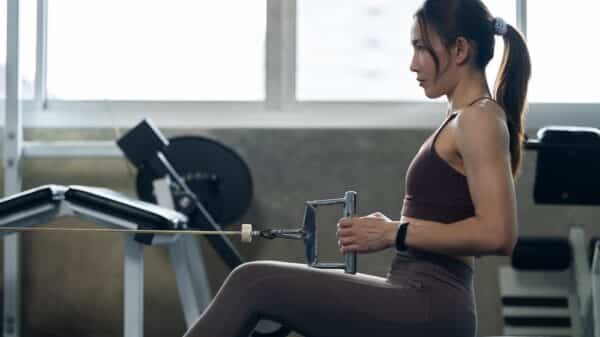
Seated Cable Row: 3 sets | 6–8 reps | 2–3 min rest
To ensure consistent progress, utilize a double progression model. Select a weight that keeps you within the target rep range while staying 1 to 2 reps away from total failure. Once you can perform the maximum number of reps in the range for your first set, increase the weight for the next session.
Overhead Press vs. Military Press vs. Shoulder Press: Understanding the Differences
While these terms are frequently used interchangeably in the gym, there are subtle distinctions in their technical definitions. Some strength experts define the military press as a stricter version of the overhead press where the feet are closer together and the lower body remains completely static. In this view, any movement of the hips or slight arching of the back would categorize the lift as a standard overhead press.
In a practical setting, “military press” usually refers to the standing barbell overhead press. The dumbbell shoulder press is another common variation; while it requires more balance and may limit the absolute amount of weight you can lift, it targets the same primary muscle groups. Because the barbell and machine versions allow for easier loading and progression, they are often prioritized for building raw strength.
A smart training strategy is to rotate these movements. You might focus on the barbell overhead press for a two-month block, then switch to the dumbbell shoulder press after a deload period. This variety helps prevent plateaus and reduces repetitive strain while ensuring comprehensive shoulder development.
Anatomy of the Lift: Muscles Targeted by the Barbell Press
The barbell overhead press is a foundational compound movement that engages several major muscle groups simultaneously:
The Deltoids: The exercise heavily recruits all three heads of the shoulder. The anterior (front) and lateral (side) deltoids do the majority of the work. To achieve the “3D” shoulder look, it is helpful to supplement the overhead press with lateral raises and rear delt flies to ensure the posterior head is not lagging.
The Pectorals: This lift involves significant shoulder flexion, which engages the upper chest (the clavicular head of the pectoralis major). This makes it an excellent secondary movement for chest development.
Stabilizer Muscles: As the weight gets heavier, the overhead press transforms into a full-body challenge. Your core, glutes, and legs must contract forcefully to provide a stable base, while the lats, rhomboids, and serratus anterior work to stabilize the shoulder blades. However, if these stabilizers fatigue before your shoulders do, the effectiveness of the exercise for direct shoulder growth may decrease.
Final Takeaway
The overhead press is a cornerstone of upper-body strength and hypertrophy. By understanding the different variations—from the stability of the machine press to the raw power of the barbell press—you can tailor your workouts to your specific goals. For the best results, focus on progressive overload, maintain strict form to protect the shoulder joints, and use a variety of accessory movements to ensure balanced development across all three deltoid heads.